FAR INFRARED RAYS
The warmth that meets well-being
Not all heat is created equal.
Far Infrared Rays (FIR) are a form of invisible infrared radiation perceived by the body as gentle, enveloping warmth. This technology has been studied for years for its potential role in muscle comfort, microcirculation, relaxation, and recovery processes.
At AgriLab, we have chosen to integrate FIR into our approach because it aligns very closely with our philosophy: not to force the body, but to create the conditions for it to more easily regain its balance.
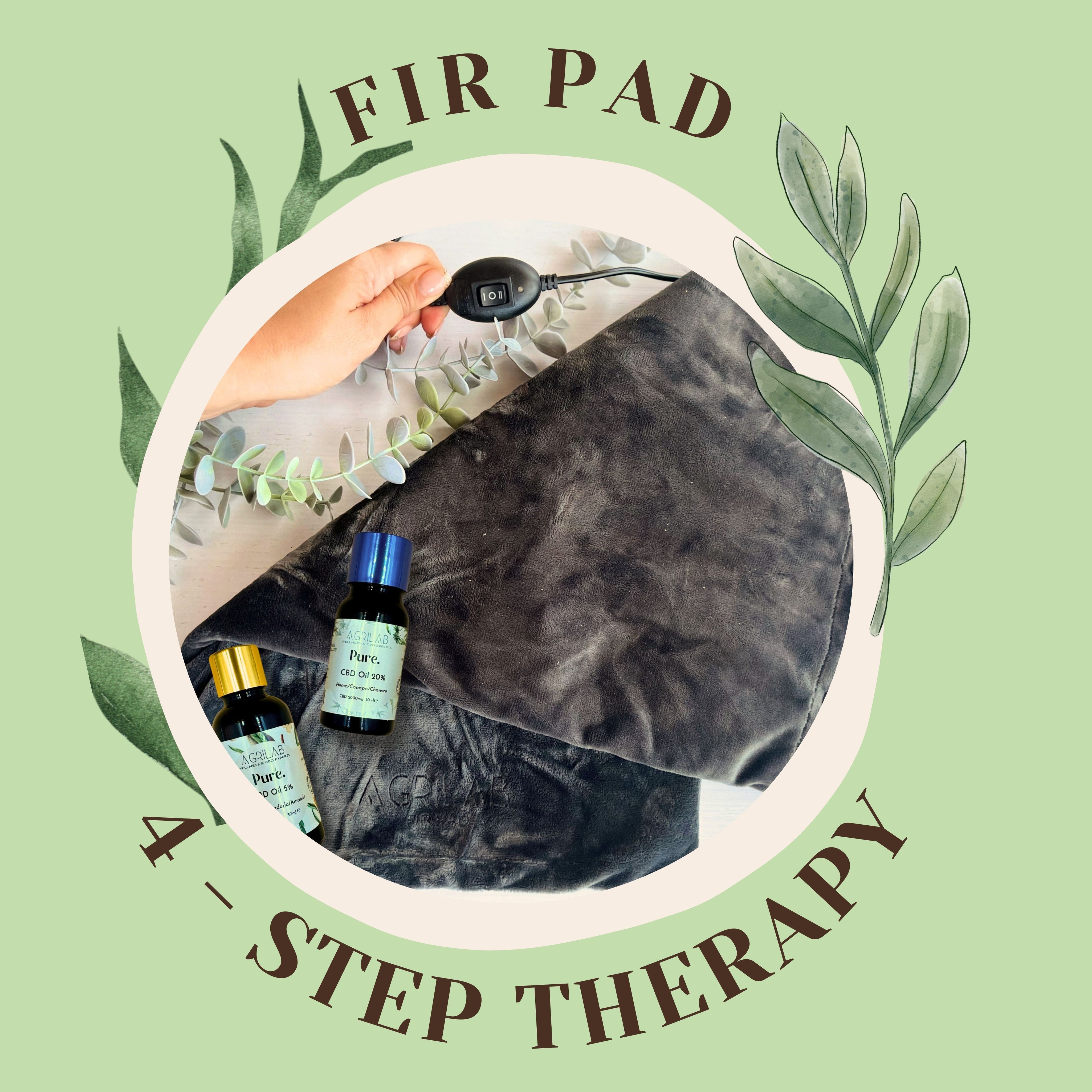
Our FIR Pad operates at moderate temperatures, without the aggressive heat of a traditional source, and can be comfortably used during moments dedicated to one's well-being.
For us, FIR is not just "heat."
It is the third pillar of the AgriLab Method, alongside isolated CBD, the Endocannabinoid System, and Nitric Oxide.
Warmth. Circulation. Balance.

Not all heat is created equal
Far Infrared Rays are part of the electromagnetic spectrum and are invisible to the human eye. When absorbed by tissues, their energy is perceived as deep, gradual, and comfortable warmth.
The difference compared to a normal heat source is not just in temperature, but in how infrared energy is transferred and absorbed by the body.
The AgriLab FIR Pad operates in the 4–16 µm range, a far infrared band chosen to offer a controlled and gentle heat experience, maintaining the temperature within approximately 40 °C.
This allows FIR to be used as part of a moment dedicated to well-being, relaxation, and recovery, without the intense heat sensation typical of other thermal sources.
And this is precisely where FIR becomes interesting for our approach: we don't just want to warm a body area, but to use heat as a physiological stimulus within a broader path of balance and well-being.
Gentle warmth on the outside. A physiological response that arises from within.
From warmth to microcirculation
When the body receives a moderate thermal stimulus, it doesn't just "feel warm." A series of physiological responses are activated, involving peripheral circulation, blood vessels, and local tissue metabolism.
Far Infrared Rays are studied precisely for their ability to produce gradual tissue warming and promote a vascular response. With the increase in local temperature, small vessels tend to dilate, and blood flow can increase, contributing to improved perfusion of the treated area.
But for AgriLab, there's an even more interesting aspect: research on FIR has highlighted a possible involvement of the endothelium, the thin layer of cells lining the inside of blood vessels, and biological pathways related to the production of Nitric Oxide (NO).
Nitric Oxide is one of the main molecules used by the body to regulate vascular tone and microcirculation.
This is where the different pillars of our approach begin to connect: FIR, microcirculation, and NO are not separate concepts, but parts of the same physiological dialogue.
Well-being also comes from good communication between tissues, blood, and cells.
![]()

Why AgriLab chose FIR
We started studying far infrared because we were looking for a tool that could fit into our wellness approach in a simple, non-invasive, and complementary way.
This research led to the creation of the AgriLab FIR Pad, designed to emit far infrared in the 4–16 µm range and operate at a moderate temperature, up to approximately 40 °C.
The choice was not to create a simple heat source. We wanted a tool that could accompany the body in a moment of relaxation and comfort, leveraging technology studied for its interactions with tissues and vascular response.
The FIR Pad has thus become an integral part of the AgriLab Method and is also used alongside isolated CBD in our 4-Step approach.
For us, it perfectly embodies a philosophy that underpins everything we do: using gentle and controlled stimuli to support the body's natural balancing mechanisms.
Easy-to-use technology. Research behind every choice. Well-being at the center.
A technology studied for over thirty years
Far Infrared Rays are not a new wellness trend.
Research on their biological effects has a long history, with a particularly important role played by Japan, where as early as the late 1980s, systems capable of emitting far infrared in the 4–16 μm range and their possible interactions with cells and tissues were being studied. A scientific publication from 1989 already explicitly described the biological activity of FIR and the use of ceramic emitting materials precisely in this wavelength band.
Also in Japan, in 1989, Professor Chuwa Tei developed a controlled form of thermal therapy using a far infrared sauna. Since then, this approach has been studied for decades, particularly in the context of cardiovascular function, circulation, and endothelial response.
Over time, research on FIR has further expanded. Experimental and clinical studies have investigated their relationship with microcirculation, vascular function, endothelium, oxidative stress, and cellular mechanisms, while more recent scientific reviews continue to explore their parameters, mechanisms, and possible applications. The literature therefore does not consider FIR a newly emerged technology, but a field of research developed through over thirty years of studies.
Infrared as a thermal technology also has a long history in the medical and neonatal fields; Far Infrared Rays represent a specific band of this spectrum, studied for over thirty years for its particular interactions with the body.
Well-being can also start with warmth
For AgriLab, FIR represents much more than a heat source.
They are a simple, non-invasive tool consistent with our understanding of well-being: to accompany the body, not to force it.
Integrated into the AgriLab Method, Far Infrared Rays become the link between comfort, microcirculation, and Nitric Oxide, naturally preparing the transition to the fourth pillar of our approach.
Gentle warmth. Physiological response. Conscious well-being.
DISCOVER THE FIR PAD